Introduction
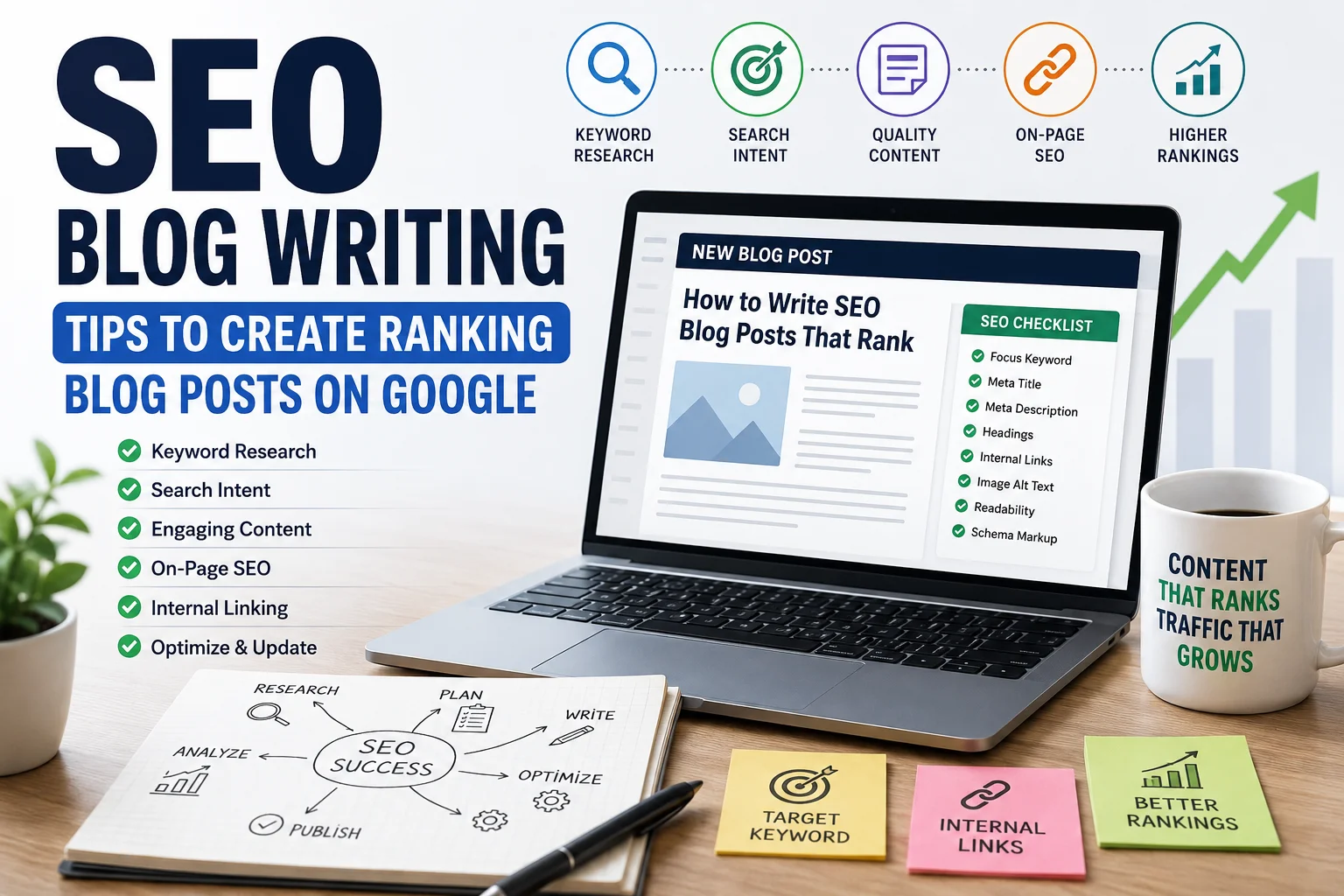
SEO blog writing has undergone tremendous changes within the last several years. Placing one blog post stuffed with relevant keywords will not be enough to rank on Google anymore. Nowadays, search engines favor content which is beneficial, reliable, well-organized, and written in a reader-friendly style. Google has introduced its helpful content concept and the E-E-A-T guidelines in order to reward content that is experienced, expert, authoritative, and trusted. (Source)
If you want to make sure that your blog posts are ranked on the first page of Google, you should have a plan in order to combine good writing skills with SEO optimization tricks. From writing a compelling introduction to optimizing older blog posts, every single step counts.
SEO Blog Writing Understanding
SEO blog writing refers to the creation of content that is not just SEO optimized but also meaningful for users reading the text. The objective here is not to stuff some keywords in the text. In contrast, effective SEO blog writing enables search engines to understand the article while providing useful answers to questions.
The current SEO practices rely strongly on search intent. Industry research from Ahrefs and Semrush consistently emphasizes that matching content to user search intent is essential for stronger organic performance. Google ranks pages that offer quick solutions to queries and help users. Content that provides answers to questions, offers helpful tips, and is informative, interesting, and accurate ranks well compared to texts created solely for algorithm purposes. Pages that produce low-quality, irrelevant, repetitive articles usually struggle with their ranking due to their lack of unique information.
It is essential to consider one more aspect of SEO blog writing – it should be readable and not overloaded with keywords. Blog posts should be informative and engaging to read, not full of keywords that do not provide any meaning. A good SEO article combines the presence of necessary keywords with high-quality text.
Keyword Research: The Key to SEO Success
The first step to creating a successful SEO blog post is conducting proper keyword research. Keywords provide search engines with information on what the content is all about. They enable you to relate to the search terms being used by people looking for the information.
Select one major keyword for your blog post based on the subject matter. After that, you should integrate secondary keywords and long-tail keywords that will assist you in focusing on the major keyword. Long-tail keywords are very useful since they focus on the intentions of the users and compete less with other keywords. For instance, instead of targeting a general keyword like “SEO,” choose a specific one like “SEO blog writing tips.”
Recognizing the search intent of the user is equally critical. There may be users who are looking for information, and there are also those who need solutions, products, or comparisons. The content needs to align with the expectations of the users. For instance, when someone enters the phrase “tips for creating blog posts that appear on Google,” he expects practical tips to be provided to him and not any definition.
Competitor articles may also assist in identifying any gaps that may be present in other websites. Analyzing the top-ranking web pages will enable you to craft content that exceeds theirs.
Blog Structure for SEO Creation
A good blog structure can not only benefit the user but also boost the SEO ranking of your website. Users would appreciate a well-organized blog, and the search engines will be able to crawl and understand the content of the articles better.
The article needs to have an attractive H1 title featuring the most relevant keywords. Following this, you should include H2 and H3 subtitles in the article to separate content into different parts. It will help both the reader and Google comprehend the main ideas discussed in the post.
Short paragraphs, bullet points, and lists would enhance the readability of the article. Since most people tend to read online content by skimming it first, large portions of text may make them leave the page without even checking out the rest of the content.
Another important factor is internal linking. This can be used to link other relevant blog posts to allow the users to find more information and help build your site’s overall SEO framework. External linking to reputable sites could help to give more credibility as well.
Optimized URLs and meta descriptions are two other critical elements. URLs should be kept short and descriptive. The meta description should explain what the article contains and should compel users to click on it. While a meta description does not influence rankings directly, it is still very important.
The Hook Effect: Getting Noticed from the Start
It all begins with how you open your blog post, which will determine if the reader will keep reading or click away in just seconds. The art of good hook writing is an often-ignored element of SEO blog writing, but it plays an essential role.
A great hook should instantly grab the attention of the reader regarding their problem, curiosity, or objective. One method for doing so involves asking a compelling question. Take this one: “Why do certain blog posts show up on Google searches, while others simply vanish?”
Surprising statistics and facts may also make for an interesting hook. Saying that several thousand blog entries are being written each day already gives you a sense of the amount of competition out there. Storytelling is yet another powerful way to grab your audience’s attention.
An introduction that doesn’t do its job well would sound rather generic and wouldn’t give the reader any reason to continue reading. Good introductions give readers the reason why they should keep going with just one sentence. Google is also taking into account engagement signals, which means that good introductions get better results in searches.
Creating In-depth Articles with Good Content
Creating content with good depth is an integral ranking factor in today’s SEO. Short, shallow articles will hardly be able to rival in-depth guides that provide comprehensive answers to all of the user’s questions. Google increasingly emphasizes the quality of content that proves its expertise, accuracy, and worth to readers.
Firstly, creating deep articles means exploring a topic from all possible angles, providing answers to all relevant questions, giving examples, and offering advice that people can implement right away. This approach creates authority around the discussed topic and allows the article to rank for multiple keywords.
Secondly, originality counts as much as depth. Rewriting other authors’ articles is pointless since this practice doesn’t benefit anyone. Providing an original perspective with real insights and useful recommendations based on experience makes your content more credible.
However, the depth of content does not imply writing a lot of irrelevant details just to increase the word count. All the content included must add some value to the reader. Nevertheless, in-depth pieces tend to become rather long because they explore topics completely.
How Long Should Your Blog Be for SEO?
Bloggers frequently ask themselves whether long blog posts will be ranked higher by Google. Although there is no one perfect number of words for all blogs, it is true that most long blog posts get good rankings because they explain the issues thoroughly and answer user queries. Backlinko’s large-scale SERP studies have found that comprehensive content often performs well when it thoroughly addresses user queries.
Short articles may be suitable for straightforward subjects; however, complex keywords require more information. Blog posts ranging from 1,200 to 2,000 words usually do well since they are both comprehensive and easily understandable. Nonetheless, the best length will vary depending on what users want to know and how complicated their search terms are.
Readability is crucial in writing long-form content. Readers tend to lose interest in lengthy blog posts if they are boring and confusing. It is best to divide sections into smaller parts, add headings, examples, and bullet points.
The primary consideration is not length but value. Google prefers articles that answer search intents rather than overly long and redundant blog posts. In some cases, shorter articles might even outrank longer articles.
Optimizing On-Page SEO Elements
On-page SEO is crucial in helping search engines better understand your content. While keyword placement still matters, optimizing must never appear forced.
Place your main keyword in the title tag, the introduction, headings, meta description, and the conclusion. Your secondary keywords and semantic keywords should be sprinkled naturally throughout your article. With semantic SEO, your content can be understood without depending on exact keyword matches.
User experience and readability are also vital parts of on-page SEO. Mobile optimization, quick page loading times, and an aesthetically pleasing design will boost engagement and lower bounce rates. Today, search engines consider user experience a priority when ranking websites.
Finally, do not overlook image optimization. Utilize descriptive file names and descriptions for images, providing even more information to search engines. You should also use internal links within your website to improve SEO.
Upgrading Existing Information for Better Rankings
While generating new content is essential, upgrading existing articles can yield quicker SEO benefits. Trends and statistics are constantly changing, and your competitors keep working on their articles. Regular upgrades will help you stay up-to-date and improve your rankings over time.
Content refresh strategies recommended by Semrush show that updating outdated posts with new information can improve relevance and visibility
First, identify the blog posts that do not perform well. Upgrade any outdated data and statistics, rewrite your content for better readability, add fresh examples, and update your keyword choices depending on search trends. Repair any broken links and incorporate newer statistics into your article to keep it current.
Fresh and relevant content is a valuable signal to Google, particularly if your website deals with evergreen topics. Updating old articles means that your website remains active and credible. Most websites see significant increases in traffic from upgrading their old content rather than generating new articles.
Content auditing should become a routine part of your SEO efforts. You should review and upgrade older articles every few months.
Essential SEO Blog Writing Tools
Choosing proper tools can help to raise the bar when it comes to content creation, keyword research, and performance metrics.
AnswerThePublic

Best for:
- Topic research
- Identifying genuine user queries
- Generating long-tail keyword ideas
- Determining search intent
Creating FAQ sections
AnswerThePublic allows you to dig deep into the specific search queries used by people on Google. Once you input your website link or any topic related to your industry, AnswerThePublic provides an extensive list of content ideas and search queries associated with your industry.
For instance, if your website is dedicated to SEO or content marketing, AnswerThePublic may provide you with the following topics:
- How to create SEO friendly blog posts
- What should be the perfect blog post length for SEO
- How frequently should you update your blogs
- Why is search intent important for SEO
This tool helps you get familiar with the search queries people use on Google, which allows you to plan your content better.
This tool can help you particularly with the following tasks:
- Developing blog calendars
- Identifying untouched content opportunities
- Broadening topic authority
- Creating FAQ sections
- Improving semantic SEO
- Boosting search visibility for AI
AnswerThePublic, along with other tools such as Google Search Console, Ahrefs, and Semrush, is one of the best ways to develop content strategies based on real searches.
Google Search Console
Suitable for:
- Impression monitoring
- CTR monitoring
- Underperforming pages discovery
- Keyword opportunities identification
- Ahrefs
Ahrefs
Suitable for:
- Keyword research
- Competitor analysis
- Backlinks monitoring
- Content gap analysis
- Semrush
Semrush
Suitable for:
- Search intent analysis
- SEO audit
- Ranking monitoring
- Topic research
- Grammarly
Grammarly
Suitable for:
- Grammar improvement
- Improving readability
- Adjusting tone
- Minimizing awkward phrases
- SurferSEO
SurferSEO
Suitable for:
- Content optimization
- Semantic keyword suggestion
- Structure suggestion based on SERP
SEO Mistakes in Blog Writing to Avoid
A classic SEO mistake that should be avoided at all costs is keyword stuffing. It makes for unreadable and uninteresting content while also negatively impacting your search engine rankings. Current search engines recognize context, and natural language and semantic keywords perform much better. Google’s spam policies specifically discourage keyword stuffing, favoring natural language and user-focused optimization.
Failing to consider the search intent of the user is yet another common SEO mistake. You may have a well-written blog post, but if you do not answer the reader’s question, then they will probably leave your website and go elsewhere. Before starting the writing process, take the time to consider the user’s intention behind the search query.
Finally, an unappealing introduction and headline can ruin the SEO success of your post. If users are not interested from the very start, engagement signals will drop, leading to increased bounce rates.
Conclusion
Blog writing for SEO has nothing to do with trying to figure out Google’s algorithm or keyword stuffing. Today, Google gives preference to blog posts that are helpful, credible, informative, and written with an end-user in mind. Blog post structure, good hooks, valuable information, and updating old articles can help increase website traffic and engagement.
In conclusion, effective SEO blogging should be done through offering high-quality blog content to users while using SEO tactics simultaneously. Thus, if you combine SEO blogging and high-quality writing skills, you will be able to achieve the desired results and create blog posts that will rank in Google and generate consistent organic traffic.
Contact Bizmeo
Have questions about SEO content writing? Need high-performing blog posts that actually rank? Let’s talk.
At Bizmeo, we help businesses create strategic, search-optimized content that drives traffic, builds authority, and converts readers into customers. Whether you need blog content, website copy, or a full content strategy, we’re ready to help.


